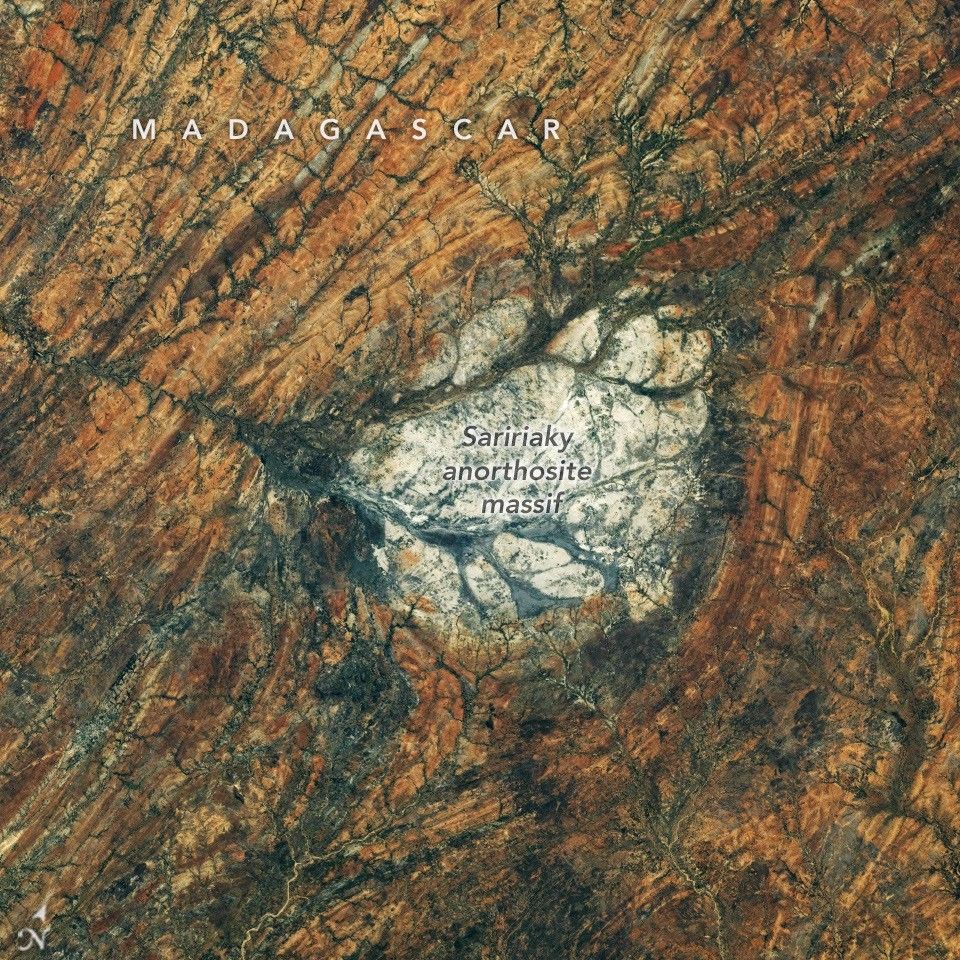
A bright patch of rock in southern Madagascar bears an unusual resemblance to the lunar surface. An astronaut aboard the International Space Station photographed the Saririaky anorthosite massif on Aug. 28, 2026, revealing a roughly circular outcrop surrounded by strongly patterned rocks.
Anorthosite is an intrusive igneous rock that is relatively uncommon on Earth but widespread on the Moon. Lunar anorthosites make up the bright, reflective areas known as the lunar highlands. Scientists estimate the Saririaky massif formed at least 600 million years ago, and its exposed surface covers about 100 square kilometers (40 square miles).
The surrounding linear patterns record intense deformation associated with the formation of the ancient supercontinent Gondwana. Terrestrial anorthosites also provide scientists with useful analogs for studying the Moon, where samples of the rock returned by Apollo astronauts are more than 4 billion years old.
Image Credit: ISS Crew Earth Observations Facility and the Earth Science and Remote Sensing Unit at NASA Johnson Space Center
Featured
Moon-Like Madagascar